

You’ve probably already ruled out tiny toy breeds that seem too fragile and giant breeds that feel like too much to handle, and that instinct is exactly right. But with dozens of medium size dog breeds to choose from, each with wildly different energy levels, grooming demands, and personalities, “medium” is just the beginning of the decision.
In this guide, you’ll get detailed profiles of all 25 of the best medium-sized dog breeds, organized by lifestyle, so you can find the one that truly fits your home, your family, and your routine.
Key Takeaways
- Medium size dog breeds typically weigh between 20 and 60 pounds and stand 18 to 22 inches tall, making them adaptable to a wide range of living situations from apartments to large homes.
- Popular medium size breeds include the Beagle, Cocker Spaniel, Border Collie, Bulldog, Australian Shepherd, Whippet, and Boxer – each with distinct temperaments and care needs.
- Medium dogs generally live longer than large or giant breeds, with most averaging 10 to 15 years, offering families a longer companionship window.
- Choosing the right medium breed depends on your activity level, living space, experience with dogs, and household composition – there is no universally “best” breed, only the best fit for your lifestyle.
- Several medium size breeds are considered hypoallergenic or low-shedding, including the Standard Poodle, Portuguese Water Dog, and Soft Coated Wheaten Terrier, making them suitable for allergy-prone households.
- Medium size dogs typically cost less to feed, house, and provide veterinary care for than large breeds, while being more durable and active than most small breeds.
- Adopting a medium size dog from a rescue or shelter is a viable and rewarding option, as medium breeds are among the most commonly available in shelters across the United States.
What Is a Medium Size Dog Breed?

A medium size dog breed is generally defined as a dog that weighs between 20 and 60 pounds and stands between 18 and 22 inches tall at the shoulder, though exact thresholds vary slightly by kennel club and breed registry.
The American Kennel Club (AKC) doesn’t use a single rigid size chart for all breeds, which means some sources classify the upper end of “medium” differently, with large breeds starting anywhere from 50 to 70 pounds depending on the organization.
For practical purposes, the 20–60 lb range is the most widely accepted benchmark for medium dogs. This covers an enormous variety of body types, from the compact, muscular English Bulldog to the lean, athletic Whippet, both technically “medium” despite looking nothing alike. “Small dog breeds”: your small dog breeds guide generally caps out below 20 pounds, while your large dog breeds guide starts above 60 pounds.
Size classification matters far beyond labels. It directly shapes decisions about food portion sizes, exercise needs, apartment suitability, travel logistics, and even average lifespan. Understanding where a breed falls on the size spectrum is step one in finding your perfect match.
Why Medium Size Dog Breeds Are the Most Popular Choice
Medium size dog breeds are widely considered the most versatile category of dogs because they adapt well to both apartment and house living, are sturdy enough for active families, and are generally more affordable to care for than large or giant breeds. This versatility is a big part of why they dominate shelter populations and breeder waitlists alike.
Moreover, the numbers back this up. According to the American Pet Products Association (APPA), approximately 65.1 million U.S. households own at least one dog, and surveys consistently show that mid-size breeds rank highest in adoption preference.
Source: APPA National Pet Owners Survey, 2023–2024. First-time owners, in particular, gravitate toward medium dogs because they strike a balance between manageability and robustness.
The average lifespan of a medium-sized dog breed ranges from 10 to 15 years, which is longer than most large breeds and shorter than most small breeds, reflecting the well-documented inverse relationship between dog size and longevity. Source: American Veterinary Medical Association, 2022. That longer window means more years of companionship, more memories, and a deeper bond with your family.
Plus, the cost equation is favorable. Annual food costs for a medium dog average $250–$700, compared to $500–$1,000+ for large breeds – Source: Forbes Advisor Pet Ownership Cost Report, 2024. Veterinary procedure costs from spay/neuter surgery to orthopedic care also scale with body weight, meaning medium dogs typically cost less at the vet than their larger counterparts.
What Are the 25 Best Medium Size Dog Breeds? (Full Profiles by Lifestyle)
The best medium size dog breeds span a wide spectrum of temperaments, energy levels, and care requirements, which is why organizing them by lifestyle category is the most useful approach for prospective owners.
Rather than ranking them by popularity, we’ve grouped all 25 breeds below by who they’re genuinely best suited for so you can skip straight to the section that matches your life.
Here’s a quick reference table before diving into the full profiles:
| Breed | Weight (lbs) | Energy Level | Best For | Hypoallergenic |
|---|---|---|---|---|
| Beagle | 20–30 | Medium | Families, beginners | No |
| Cocker Spaniel | 20–30 | Medium | Families, seniors | No |
| Border Collie | 30–55 | Very High | Active owners | No |
| Australian Shepherd | 40–65 | High | Active families | No |
| Boxer | 50–70 | High | Families with kids | No |
| English Bulldog | 40–50 | Low | Apartments, seniors | No |
| Whippet | 25–40 | Medium | Apartments, runners | No |
| Standard Poodle | 40–70 | Medium-High | Allergy households | Yes |
| Portuguese Water Dog | 35–60 | High | Active families | Yes |
| Soft Coated Wheaten Terrier | 30–45 | Medium | First-timers, allergy | Yes |
| Brittany Spaniel | 30–40 | High | Outdoor enthusiasts | No |
| Vizsla | 44–60 | Very High | Runners, active owners | No |
| Basenji | 22–24 | Medium-High | Apartments, quiet homes | No |
| English Springer Spaniel | 40–50 | High | Active families | No |
| Shetland Sheepdog | 15–25 | Medium | Families, seniors | No |
| Keeshond | 35–45 | Medium | Families, first-timers | No |
| Pembroke Welsh Corgi | 25–30 | Medium-High | Families, apartments | No |
| Siberian Husky | 35–60 | Very High | Active, experienced owners | No |
| Airedale Terrier | 40–65 | High | Experienced owners | No |
| Nova Scotia Duck Tolling Retriever | 35–50 | High | Active families | No |
| Am. Staffordshire Terrier | 40–70 | Medium-High | Experienced families | No |
| Bull Terrier | 45–65 | High | Experienced owners | No |
| Samoyed | 35–65 | Medium-High | Families, cold climates | No |
| Finnish Spitz | 20–33 | Medium-High | Active owners | No |
| Dalmatian | 45–70 | High | Active families | No |
👉 Read Also: Complete Dogs Breeds Guide: Types, Traits, Sizes & Care
Best Medium Size Dog Breeds for Active Families

Active families need medium dog breeds that can match their pace, handle rough-and-tumble play with children, and still settle down calmly at the end of the day. The following six breeds are built for exactly that.
1. Boxer (50–70 lbs)
The Boxer is a muscular, energetic, and deeply loyal dog that is one of the most popular family breeds in America, and for good reason. Boxers are playful, patient with children, and protective without being aggressive. They need at least 60 minutes of vigorous exercise daily. Their short coat is easy to maintain, though they are prone to certain heart conditions and hip dysplasia.
2. Border Collie (30–55 lbs)
The Border Collie is widely recognized as the most intelligent dog breed in the world, scoring consistently at the top of canine cognition studies. Source: Dr. Stanley Coren, The Intelligence of Dogs, updated rankings 2023.
This breed thrives in homes where it gets both physical exercise (at least 90 minutes/day) and mental stimulation through training or dog sports. Without adequate activity, Border Collies can become anxious or destructive. They are exceptional with children who are old enough to engage them actively.
3. Australian Shepherd (40–65 lbs)
The Australian Shepherd is a strikingly beautiful herding breed with boundless energy and an intense eagerness to please. Aussies excel at agility, frisbee, hiking, and obedience training.
They bond deeply with their family and can be reserved with strangers, making them natural watchdogs. Learning early is essential with this breed to channel their intelligence productively.
4. Vizsla (44–60 lbs)
The Vizsla is a Hungarian hunting dog that doubles as one of the most affectionate family companions in the medium-sized category. Often called “velcro dogs,” Vizslas dislike being left alone and thrive in active households where someone is almost always home. They need 60–90 minutes of exercise daily and do best in homes with a yard.
5. English Springer Spaniel (40–50 lbs)
The English Springer Spaniel is an enthusiastic, even-tempered breed that gets along beautifully with children and other dogs. Originally bred for flushing and retrieving game, Springers are athletic and love water.
Their medium-length coat requires brushing 2–3 times per week. They are among the easiest medium breeds to train, making them ideal for active families new to dog ownership.
6. Dalmatian (45–70 lbs)
The Dalmatian is an instantly recognizable breed that is far more athletic and energetic than its pop-culture reputation suggests. Dalmatians need significant daily exercise, a minimum of 60 minutes, and do best with experienced owners who can provide firm, consistent training. They are loyal, playful, and outstanding with older children.
Best Medium Size Dog Breeds for Apartment Living
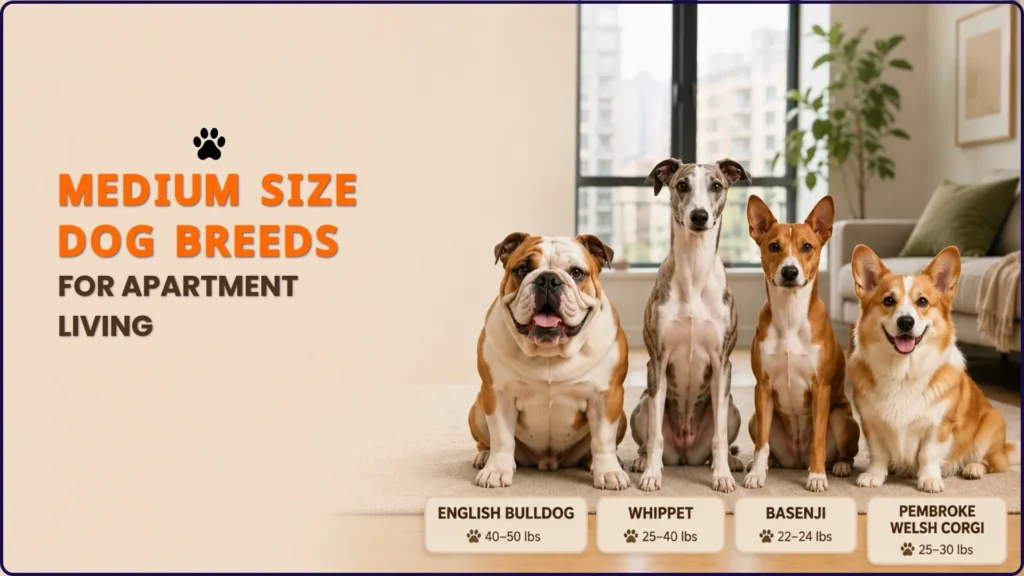
The best medium-sized dog breeds for apartment living are those with low-to-moderate energy levels, quiet temperaments, and an ability to rest comfortably indoors for extended periods without becoming destructive. Size alone doesn’t determine apartment suitability; temperament and exercise needs matter far more. Our full guide on apartment dog breeds covers both medium and small options in depth.
7. English Bulldog (40–50 lbs)
The English Bulldog is one of the most laid-back dogs in existence. Bulldogs are content with short, 20–30-minute walks and long naps on the couch, making them exceptional apartment companions. They are gentle, patient, and affectionate with children. Be aware that their flat face (brachycephalic structure) makes them sensitive to heat; always ensure access to cool, air-conditioned spaces.
8. Whippet (25–40 lbs)
The Whippet surprises many people: despite being built like a racing greyhound, Whippets are calm, quiet, and remarkably low-maintenance indoors. They need one or two good runs per day (ideally in a securely fenced area), but after that they’re content to curl up and sleep for hours. Whippets are gentle, sensitive dogs that respond poorly to harsh training; positive reinforcement is a must.
9. Basenji (22–24 lbs)
The Basenji is often called the “barkless dog” because it doesn’t bark in the traditional sense, instead producing a yodel-like sound called a “barroo.” This makes it uniquely suited to apartment buildings with noise-sensitive neighbors. Basenjis are independent, cat-like in personality, and tidy in their habits. They are better suited for experienced dog owners who appreciate a challenge.
10. Pembroke Welsh Corgi (25–30 lbs)
The Pembroke Welsh Corgi is compact, adaptable, and surprisingly well-suited to apartment life despite its herding heritage. Corgis need moderate daily exercise, around 30–45 minutes, and are highly trainable, affectionate, and entertaining. They can be vocal, so early training to curb excessive barking is recommended.
Best Medium Size Dog Breeds for First-Time Owners

The best medium-sized dog breeds for first-time owners are those that are eager to please, respond well to positive reinforcement training, and don’t require intensive grooming or highly specialized care. Learning “how to choose the right dog breed” before committing is always a smart first step.
11. Beagle (20–30 lbs)
The Beagle is one of the most beginner-friendly dogs in the world, friendly, sturdy, curious, and consistently ranked among the most popular breeds in the U.S. Source: AKC Most Popular Dog Breeds, 2023.
Beagles are scent hounds, so they require a securely fenced yard or leashed walks at all times. Their short coat is virtually maintenance-free. The main challenge is their nose: a Beagle that catches an interesting scent will follow it single-mindedly, so recall training is a must.
12. Cocker Spaniel (20–30 lbs)
The Cocker Spaniel is a gentle, joyful, and moderately active dog with a beautiful silky coat and an incredibly warm temperament. Cockers are easy to train, great with children, and adapt well to different living environments. Their coat requires professional grooming every 6–8 weeks, which is the primary ongoing commitment owners should anticipate.
13. Shetland Sheepdog (15–25 lbs)
The Shetland Sheepdog (Sheltie) sits at the smaller end of the medium range, but its personality is enormous. Shelties are exceptionally smart, ranking 6th in canine intelligence studies, and respond beautifully to consistent, reward-based training. They are gentle with families and somewhat reserved with strangers, making them natural, gentle watchdogs. They do shed significantly, so daily brushing is recommended.
14. Keeshond (35–45 lbs)
The Keeshond is an often-overlooked gem for first-time owners: happy, adaptable, and deeply people-oriented. Keeshonds are sometimes called “Velcro dogs” because they want to be wherever you are. They do well in apartments or homes and need moderate daily exercise. Their thick double coat requires regular brushing, but they are otherwise low-maintenance and rarely stubborn.
15. Soft Coated Wheaten Terrier (30–45 lbs)
The Soft Coated Wheaten Terrier combines the friendly, trainable nature of a companion dog with the playful confidence of a terrier, and its low-shedding coat is a bonus for allergy sufferers. Wheatens are energetic but not overwhelming, making them manageable for new owners willing to invest in early socialization and obedience work.
Best Medium Size Dog Breeds for Seniors or Less Active Owners

Medium size dog breeds that work best for seniors are those that are calm, affectionate, low-energy, and content with gentle daily walks rather than intense exercise sessions.
16. Cocker Spaniel (20–30 lbs)
The Cocker Spaniel is an excellent choice for first-time dog owners and seniors thanks to its gentle, affectionate, and eager-to-please nature. These cheerful companions are easy to train, get along wonderfully with children and other pets, and adapt well to both apartments and houses.
While they enjoy daily walks and playtime, they don’t require intense exercise, making them well-suited for less active households. Their beautiful silky coat does require regular brushing and professional grooming every 6–8 weeks, which is the main commitment prospective owners should be prepared for.
17. Basset Hound (40–65 lbs)
The Basset Hound is slow-moving, gentle, and deeply devoted to its people. Short daily walks and plenty of indoor time suit this breed perfectly. Bassets are famously stubborn, so training requires patience, but their calm demeanor and low activity needs make them a natural fit for quieter households.
18. English Bulldog (40–50 lbs)
The English Bulldog is an excellent choice for first-time owners, seniors, and less active households thanks to its calm, affectionate, and easygoing personality. One of the most laid-back dog breeds, Bulldogs are happy with short 20–30-minute walks followed by long naps, making them ideal for apartment living.
They are gentle, patient, and wonderful with children, forming strong bonds with their families. Because of their flat-faced (brachycephalic) build, they are sensitive to heat and strenuous exercise, so owners should provide cool, air-conditioned spaces and avoid outdoor activity during hot weather.
19.Whippet (25–40 lbs)
The Whippet is an excellent choice for first-time owners and active seniors who can provide a safe space for daily exercise. Despite their athletic appearance, Whippets are calm, quiet, and incredibly relaxed indoors, happily spending hours lounging after one or two good runs or brisk walks each day.
Their gentle, affectionate, and sensitive nature makes them easy to live with, though they respond best to positive reinforcement and patient training rather than harsh correction. Because of their low-maintenance coat and peaceful temperament, Whippets are wonderful companions for owners seeking a clean, affectionate, and easygoing medium-sized dog.
Best Hypoallergenic and Low-Shedding Medium Size Dog Breeds

Hypoallergenic medium size dog breeds, including the Standard Poodle, Portuguese Water Dog, and Soft Coated Wheaten Terrier, produce lower levels of the Canis familiars allergen 1 (Can f 1) protein, making them more suitable for allergy-sensitive households. It’s important to note that no dog is 100% allergen-free; hypoallergenic means significantly lower allergen production, not zero. Our full guide on “best hypoallergenic dog breeds” explains the science behind this in detail.
20. Standard Poodle (40–70 lbs)
The Standard Poodle is intelligent, highly trainable, low-shedding, and genuinely friendly with children and other pets, a combination that makes it arguably the most well-rounded medium-to-large breed available. Poodles require professional grooming every 6–8 weeks to prevent their curly coat from matting.
21. Portuguese Water Dog (35–60 lbs)
The Portuguese Water Dog gained widespread recognition as the breed of choice for the Obama family, who have allergies. Porties are athletic, loyal, waterproof-coated, and highly trainable. They need vigorous daily exercise and thrive with active owners who enjoy outdoor activities.
22. Soft Coated Wheaten Terrier (30–45 lbs)
The Soft Coated Wheaten Terrier is a great choice for first-time owners with an active lifestyle who want a friendly, affectionate, and low-shedding companion. Combining the playful spirit of a terrier with the trainable nature of a family dog, Wheatens are energetic without being overly demanding.
They thrive on daily exercise, positive reinforcement, and early socialization, making them well-suited to owners willing to invest time in basic training. Their soft, low-shedding coat is also a bonus for households looking to reduce pet hair, though regular grooming is essential to keep it healthy and tangle-free.
23. Brittany Spaniel (30–40 lbs)
While not classified as hypoallergenic, the Brittany Spaniel is a light shedder whose short, dense coat requires minimal grooming. Energetic and extremely athletic, Brittanys are best suited for active households and are exceptional hunting companions or agility competitors.
Best Medium Size Dog Breeds Good with Other Pets

Medium dog breeds that thrive in multi-pet households tend to have low prey drives, stable temperaments, and sociable natures that allow them to coexist peacefully with cats, other dogs, and small animals.
24. Nova Scotia Duck Tolling Retriever (35–50 lbs)
The Nova Scotia Duck Tolling Retriever (“Toller”) is a playful, energetic, and adaptable breed that generally gets along well with other dogs when properly socialized from puppyhood. Tollers are intelligent, eager to please, and athletic a great fit for active families who already have other pets.
25. Samoyed (35–65 lbs)
The Samoyed is a fluffy, cloud-white spitz breed with one of the most consistently gentle and sociable temperaments in the dog world. Samoyeds are friendly with virtually everyone strangers, children, other dogs, and even cats when introduced carefully.
Their thick double coat requires frequent brushing (daily during shedding season), and they thrive in cooler climates.
How to Choose the Right Medium Size Dog Breed for Your Lifestyle
Choosing the right medium-sized dog breed requires an honest self-assessment across six key dimensions: your living space, activity level, allergy status, dog ownership experience, time availability, and household composition. No single breed is universally “best”; the best breed is the one that matches your actual daily life, not your idealized version of it.
First, consider your living space. Apartment dwellers should prioritize low-energy, quiet breeds (Bulldog, Whippet, Basenji), while homeowners with yards have a wider selection. Second, assess your activity level honestly. If you jog daily, a Vizsla or Border Collie will thrive alongside you. If long walks are your limit, a Bulldog or Basset Hound is a better match.
Third, check for allergies in your household. If anyone is sensitive to dog dander, shortlist only from the hypoallergenic options listed above. Fourth, consider your experience level. Breeds like the Airedale Terrier, Siberian Husky, and Bull Terrier require confident, experienced handling, they are not ideal starter dogs. Fifth, factor in grooming time.
Some medium breeds (Samoyeds, Cocker Spaniels) require significant coat maintenance; others (Beagles, Boxers) are nearly wash-and-go. Finally, think about your household. Families with toddlers need breeds with exceptional patience (Boxers, Beagles). Homes with cats need dogs with low prey drives (Samoyeds, Keeshonds).
Medium Size Dog Breed Care Essentials

Medium size dogs typically require 30 to 60 minutes of physical exercise per day, though high-energy breeds such as the Border Collie, Australian Shepherd, and Vizsla may need significantly more to remain healthy and behaviorally balanced. Beyond exercise, consistent care across several areas keeps your medium dog thriving.
Nutrition is foundational. Choose a life-stage-appropriate food labeled for “medium breeds”; these formulas are calibrated for the caloric density and joint-support needs of 20–60 lb dogs. Our guide on the “best dog food for medium breeds” can help you navigate commercial and fresh-food options. Avoid free-feeding; most medium breeds do better on structured meal times twice daily.
Grooming needs vary widely by breed but broadly fall into three categories: short-coated (Boxers, Beagles – brush weekly, bathe monthly), medium-coated (Cocker Spaniels, Shelties – brush 3–4x weekly, professional groom every 6–8 weeks), and curly/double-coated (Standard Poodles, Samoyeds – daily brushing, professional grooming every 4–8 weeks).
Dental hygiene, nail trimming, and ear cleaning are universal needs regardless of coat type, aim for weekly tooth brushing and monthly nail checks.
Health screening is especially important for purebred medium dogs. Common concerns include hip dysplasia (Border Collies, Australian Shepherds), heart conditions (Boxers, Cavalier King Charles Spaniels), eye conditions (Cocker Spaniels, Shelties), and brachycephalic syndrome (Bulldogs). Proactive genetic testing and annual vet checkups catch issues early. For a deep dive, see our guide to “common dog health problems by breed” .
Training and socialization should begin the day your dog comes home, whether as a puppy or an adult rescue. The first 3–16 weeks of life (the socialization window) are critical for puppies, but adult dogs benefit enormously from structured training too. Learning “how to train a dog” using positive reinforcement methods is effective for all 25 breeds on this list.
Tools, Resources & Next Steps for Prospective Owners
The most reliable tools for finding the right medium size dog breed include the AKC Breed Selector, Petfinder’s breed match tool, and local shelter adoption platforms – each serving a different stage of the decision and adoption process.
First, use the AKC Breed Selector (akc.org/dog-breeds/selector/) to filter breeds by energy level, size, shedding, trainability, and living situation. It’s free and covers all AKC-recognized breeds with detailed profiles. Second, visit Petfinder.com to search for medium dogs available for adoption in your area by breed, age, and gender, often returning hundreds of matches within 50 miles.
Third, if you’ve identified a specific breed, search for breed-specific rescues. Almost every popular medium breed has a dedicated national rescue network (e.g., Border Collie Rescue, Boxer Rescue Alliance). These organizations can answer specific breed questions and often provide dogs that are already house-trained and temperament-tested.
Additionally, visit local shelters in person before committing; meeting a dog’s energy and personality firsthand is invaluable information no website can replace.
Financially, plan using a first-year cost estimator. Our breakdown of the “first-year cost of owning a dog” covers adoption/purchase fees, supplies, food, training, and veterinary care, typically ranging from $1,500 to $4,000 for a medium dog in the first year. Once you’ve chosen your breed, “how to puppy-proof your home” will walk you through preparing your space before your new companion arrives.
Finally, if you’re on the fence between adopting and purchasing from a breeder, our honest comparison of “dog adoption vs. buying from a breeder” breaks down the pros, cons, costs, and ethical considerations of both paths.
Conclusion: Finding Your Perfect Medium-Sized Companion
Choosing a medium size dog is one of the most rewarding decisions you can make — but only if you choose the right one for your specific life. The 25 breeds in this guide span the full spectrum of personalities, energy levels, and care requirements, which means there is genuinely a medium dog for every type of owner.
Take your time. Use the tools we’ve recommended. Visit shelters and meet dogs in person. And remember: the goal isn’t to find the most popular breed or the most beautiful one;
It’s to find the dog whose energy, temperament, and needs align naturally with your home, your schedule, and your family. That dog, whatever breed it turns out to be, will be your perfect companion.
When you’re ready to take the next step, start with the “how to choose the right dog breed” and the “first-year cost of owning a dog”, and don’t hesitate to come back to BowBowMeow.com for everything you need to give your new dog the happiest, healthiest life possible.
Frequently Asked Questions About Medium Size Dog Breeds
1. What Weight Range Qualifies as a Medium Size Dog Breed?
A. A medium-sized dog breed is generally defined as weighing between 20 and 60 pounds and standing 18 to 22 inches at the shoulder. Some registries place the upper limit at 50 pounds; others extend it to 65. For practical purposes, the 20–60 lb range covers the vast majority of what most sources classify as medium.
2. Which Medium Size Dog Breeds Are Easiest to Train for First-Time Owners?
A. The easiest medium-sized dog breeds to train for first-time owners include the Beagle, Cocker Spaniel, Shetland Sheepdog, Border Collie, and Standard Poodle. These breeds are eager to please, food-motivated, and respond well to consistent positive reinforcement training methods.
3. How Much Exercise Do Medium Size Dogs Need Each Day?
A. Most medium size dogs need 30 to 60 minutes of physical exercise per day. However, high-energy breeds such as the Border Collie, Vizsla, and Australian Shepherd may require 90 minutes or more of vigorous daily activity to remain physically and behaviorally balanced.
4. What Is the Average Lifespan of a Medium Size Dog Breed?
A. The average lifespan of a medium size dog breed ranges from 10 to 15 years. This is longer than most large and giant breeds, which typically live 8 to 12 years, and somewhat shorter than small breeds, which often reach 14 to 16+ years.
5. Which Medium Size Dog Breeds Are Best for Apartment Living?
A. The best medium size dog breeds for apartment living include the English Bulldog, Whippet, Basenji, Pembroke Welsh Corgi, and Cocker Spaniel. These breeds have moderate energy levels, quiet temperaments, and can be adequately exercised with daily walks without requiring a large yard.
6. How Much Does It Cost to Own a Medium Size Dog Per Year?
A. The annual cost of owning a medium size dog ranges from approximately $1,200 to $3,500, depending on food quality, grooming needs, veterinary care, and training costs.
7. Which Medium Size Dog Breeds Are Good with Other Pets?
A. Medium-sized dog breeds that are consistently rated highly for compatibility with other pets include the Beagle, Samoyed, Cocker Spaniel, Keeshond, and Nova Scotia Duck Tolling Retriever. Early socialization is critical regardless of breed.

Hi, I’m Jak, the founder of BowBowMeow.com and a passionate pet parent who shares life with both a dog and a cat. I created this website to help fellow pet owners find reliable, easy-to-understand information about pet care, nutrition, behavior, grooming, training, and breed-specific topics.
Drawing from both extensive research and hands-on experience as a pet owner, I aim to provide practical, trustworthy content that helps dogs and cats live happier, healthier lives.
Disclaimer: I am not a veterinarian or certified animal professional. The information shared on BowBowMeow.com is for educational purposes only and should not replace professional veterinary advice, diagnosis, or treatment.